
UF Process Review for Lactose-Free Milk
Evaluate the ultrafiltration (UF) step that retains milk proteins while separating lactose, water and some dissolved minerals into the permeate. Select the membrane and process conditions for the target lactose content and finished-product composition.
Review dairy UF as a process option. Confirm the actual membrane type with the supplier. Confirm the milk-compatible UF grade, MWCO, food-contact documentation and CIP limits. UF alone does not guarantee a lactose-free product: validate any required diafiltration, recombination or lactase treatment and the final residual lactose using the actual feed.
Discuss application & supply
Industrial application examples
See where equipment is used in the process.
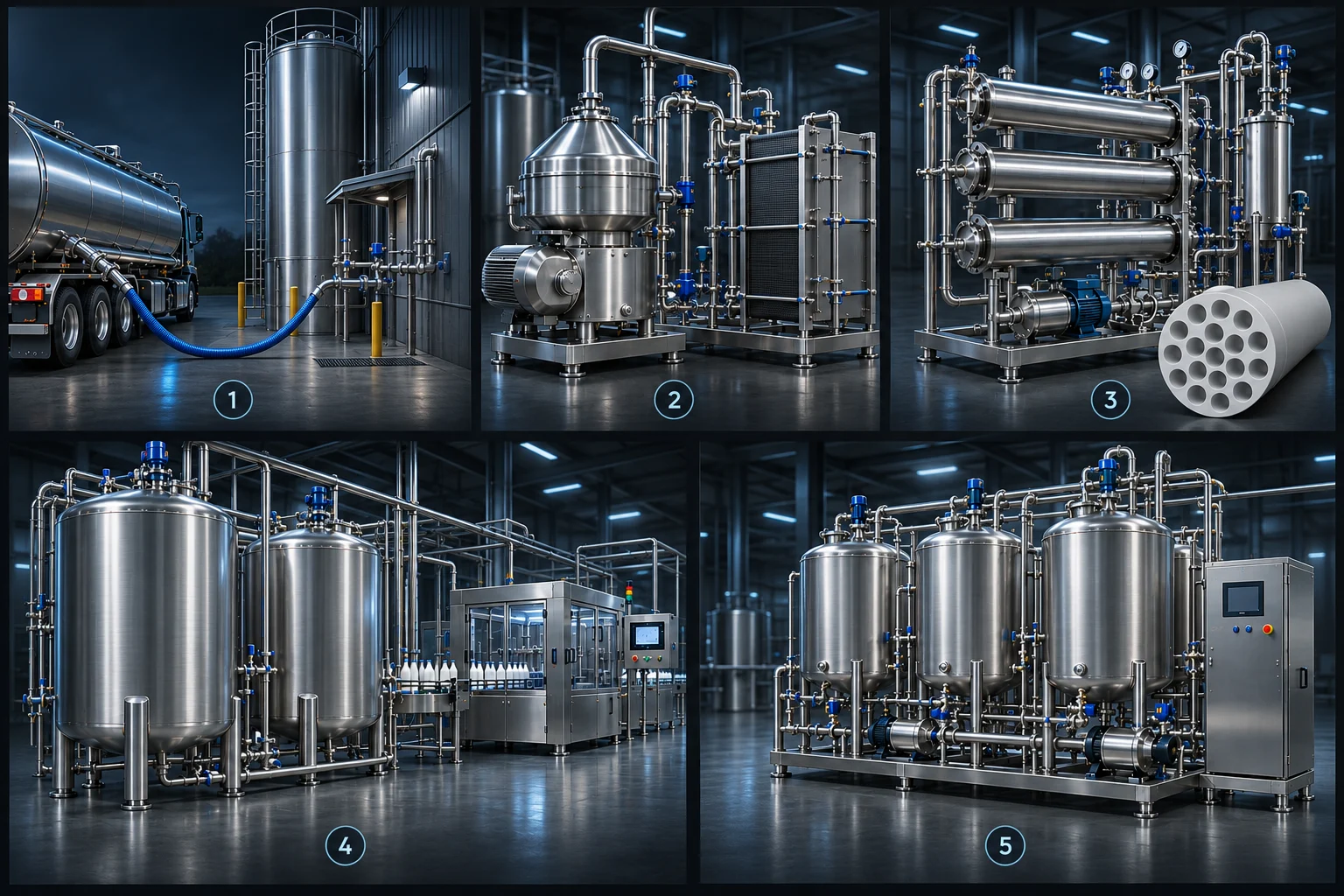
- 1 Closed reception/storage · 2 Separation/pretreatment · 3 Dairy-UF example
- 4 Product storage and subsequent processing · 5 CIP separate from production
- The cylindrical ceramic element reference and installed housing in scene 3 are distinct.
- Reception and storage
- Separation and pretreatment
- Dairy UF · element and installed circuit
- Product storage and finishing
- CIP and process utilities
Connections to review
- 01 → 02 Feed
- 02 → 03 Skim milk or pretreated whey
- 03 → 04 Selected product outlet
- 03 → 03 Retentate recycle
- 05 → 03 CIP after production
An illustrative installed context informed by manufacturer product exteriors, not an actual product/installation photograph or piping design. Ceramic elements and installed housings are distinct; dimensions, channel counts and ports are not specifications. Confirm protein retention and lactose passage for the selected UF grade and conditions. UF alone does not guarantee a final lactose-free product. MF, NF and RO are separately selected for their purpose, not the same product or mandatory serial stages. CIP is a cleaning mode separate from production.
A conceptual illustration created to explain equipment and application locations. It is not an actual product photograph, installation photograph or piping/wiring design.
Prepare selection and evaluation.
- 01Define feed and composition targets
- 02Review the dairy-UF grade
- 03Pilot UF and required later steps
- 04Verify final residual lactose
Information to prepare
- Milk type, protein, fat, lactose and processing temperature
- Target residual lactose and final protein, fat and mineral composition
- Throughput, recovery, run length and permeate handling
- UF grade/MWCO and measured protein retention/lactose passage
- DF, recombination or lactase review, CIP and residual-lactose testing
Process guidance and application references
Ceramic membrane installation in dairy processing

Illustrations show typical installation contexts, not product photos or drawings. Confirm connections and dimensions against the selected equipment's documentation.
Confirm lactose in the finished milk, not on the membrane label
Relevant manufacturer: PHILOS Co., Ltd.
- The problem on site
- Even when lactose transfers to permeate, final lactose depends on retained milk composition and subsequent blending. High initial throughput can also overstate batch capacity once viscosity and fouling rise during concentration.
- Proposed solution
- Track both the protein-rich retentate and the lactose-bearing permeate. Compare relevant options such as diafiltration or composition adjustment under site conditions. Verify whole-batch mass balance, protein recovery, sensory attributes and cleaning recovery without changing the approved heat treatment or filling conditions implicitly.
- What to verify before selection
- Prepare feed and finished targets for lactose and protein, analytical methods, intended recovery, batch duration and cleaning plan. Neither a membrane name nor a single small test establishes lactose-free labelling or suitability of a supplied product.